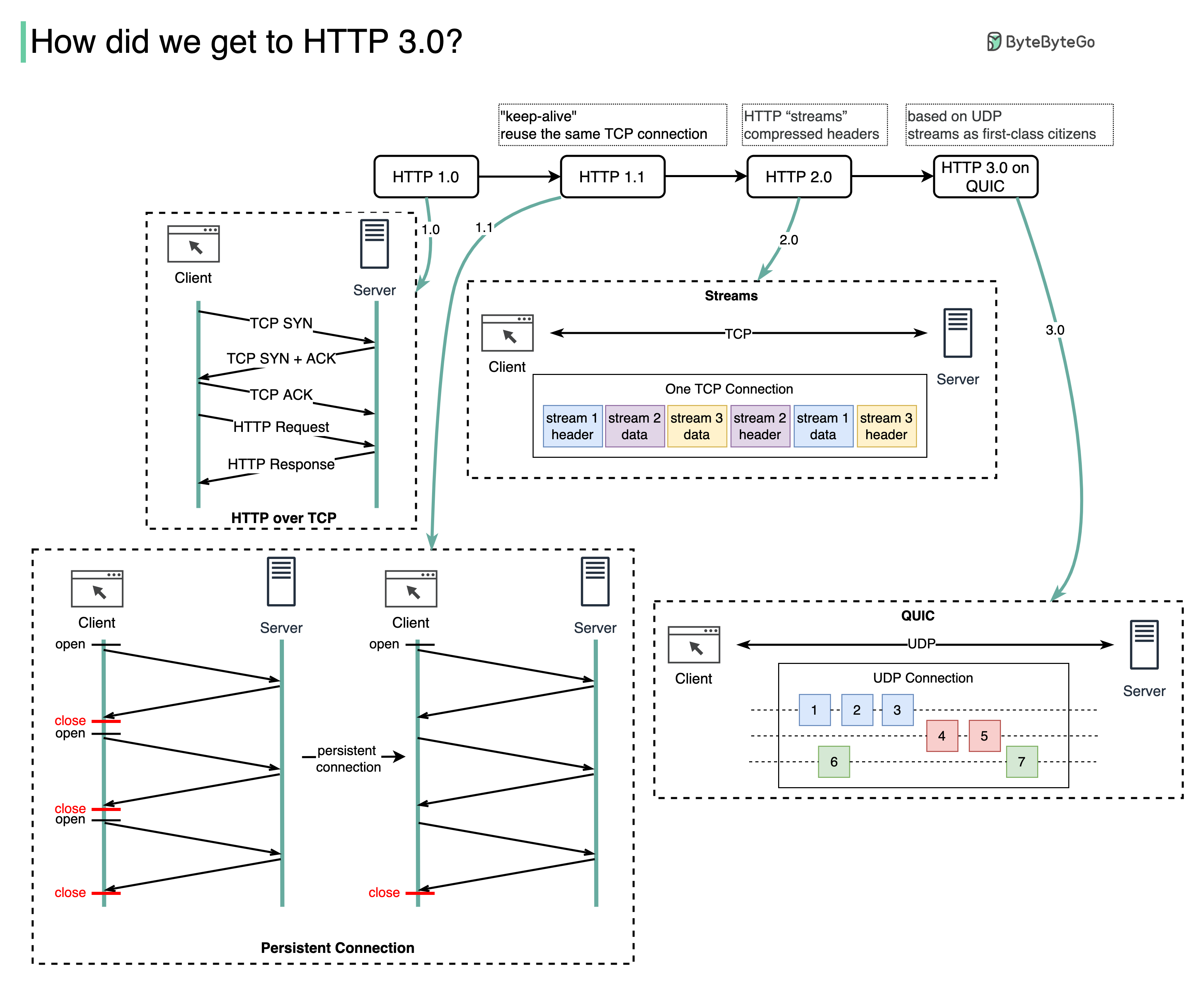
🌐 HTTP/1.1
Released: 1997
Transport: TCP
✔️ Key Features
- Plain text protocol
- One request per TCP connection (unless using keep-alive)
- No multiplexing → only one request in flight at a time
- Head-of-line (HOL) blocking at the application layer
- Responses must complete in order.
✔️ What goes over the wire?
- ASCII headers (
GET /path HTTP/1.1) - Body (optional)
- Chunked encoding for streaming
- TCP retransmissions if packets are lost
✔️ Where it can be used
- Everywhere — browsers, servers, IoT — it’s universal.
- Excellent compatibility; all proxies/firewalls understand it.
✔️ Best suited for
- Simplicity
- High compatibility environments
- Systems with old networking gear
- Simple REST APIs
❌ Limitations
- Major performance bottlenecks for parallel requests
(browsers open 6–10 TCP connections per domain to compensate) - Latency sensitive due to TCP’s strict ordering
🌐 HTTP/2
Released: 2015
Transport: Still TCP — but with a totally different framing layer.
✔️ Key Features
- Binary framing
- Multiplexing: many parallel streams over one TCP connection
- Header compression (HPACK)
- Server push (used very little today; removed in HTTP/3)
- Much more efficient use of a single TCP connection
✔️ What goes over the wire?
- Binary frames, not plain text
- Stream IDs
- Prioritization signals (rarely well-used)
Examples of frames:
- HEADERS
- DATA
- SETTINGS
- RST_STREAM
- WINDOW_UPDATE (flow control)
✔️ Where it is used
- Browsers: all major browsers support HTTP/2 for TLS connections
(HTTP/2 without TLS is almost never used) - gRPC: standard gRPC requires HTTP/2
- Modern REST APIs: significant performance boost for multiple small requests
- Server-to-server communication
✔️ Best suited for
- Microservices calling each other frequently
- gRPC
- Streaming APIs
- High request concurrency
- Performance-sensitive applications
❌ Limitations
- Still built on TCP, so:
- Packet loss affects all streams (TCP head-of-line blocking)
- Mobile networks can suffer
🌐 HTTP/3 (QUIC)
Released: 2022
Transport: QUIC, built on UDP
(But QUIC is not “just UDP” — it is a full transport layer.)
✔️ Key Features
- UDP-based, but fully reliable transport
- Eliminates TCP head-of-line blocking
- Connection migration (keep the connection alive when switching networks/WiFi)
- Faster connection setup (TLS handshake built into QUIC)
- Stream-based like HTTP/2, but without TCP’s blocking issues
✔️ What goes over the wire?
- QUIC packets containing:
- Encrypted stream frames
- Acknowledgement frames
- Cryptographic handshake data (TLS 1.3 integrated)
- Always encrypted; no plaintext mode
✔️ Where it is used
- Modern browsers (Chrome, Firefox, Edge, Safari)
- CDNs (Cloudflare, Fastly)
- Some HTTP servers: nginx, cloudflare, ASP.NET Core (from .NET 7)
Increasingly used for:
- Media streaming
- Real-time apps
- Mobile-friendly APIs
✔️ Best suited for
- Unstable network links (mobile, cross-country)
- Low-latency, high-load APIs
- Future-proofing services
- Potentially: next-generation gRPC (gRPC over HTTP/3)
❌ Limitations
- Not all corporate firewalls allow QUIC/UDP
- Still newer; some server stacks have incomplete or experimental support
- No support for server push (removed intentionally)
🏁 Summary Table: HTTP 1.1 vs 2 vs 3
| Feature | HTTP/1.1 | HTTP/2 | HTTP/3 (QUIC) |
|---|---|---|---|
| Transport | TCP | TCP + binary frames | QUIC (UDP-based) |
| Multiplexing | ❌ No | ✔ Yes | ✔ Yes |
| HOL Blocking | ✔ Application-level | ✔ TCP layer | ❌ Avoided |
| Header compression | Minimal | HPACK | QPACK |
| Encryption required? | No | Yes (in browsers) | Yes (always) |
| Browser support | ✔ Full | ✔ Full | ✔ Growing, widely deployed |
| Server-to-server suitability | ✔ Good | ✔ Excellent | ✔ Excellent (if QUIC works in environment) |
| gRPC support | ❌ No | ✔ Required | ✔ Supported in .NET 7–9 (experimental in earlier) |
| gRPC-Web support | ✔ Yes | ✔ Yes | ✔ Yes |
| Mobile performance | Poor | Medium | Excellent |
🧭 Which protocol should I use on my server?
✔ General REST APIs
- Prefer HTTP/2
- Also support HTTP/1.1 for compatibility
- Optionally expose HTTP/3 for clients that can use it
✔ gRPC server
- Must support HTTP/2
- Can optionally support HTTP/3
- Should also support gRPC-Web if you have browser clients
Recommended config:
- HTTP/2 for native gRPC clients
- HTTP/1.1 + HTTP/2 for gRPC-Web (browser)
- HTTP/3 optional for advanced clients
✔ Browser apps (Blazor WASM, React, Angular, etc.)
Cannot use real gRPC-over-HTTP/2. Your options:
✔ For browser-to-server APIs
- REST ⇒ HTTP/1.1 or HTTP/2 or HTTP/3
- gRPC-Web ⇒ HTTP/1.1 or HTTP/2
- WebSockets ⇒ custom streaming
Browser automatically negotiates protocol; you cannot force raw HTTP/2 APIs beyond fetch/XHR.
❌ Cannot do:
- Real gRPC over HTTP/2
- Real gRPC over HTTP/3 (yet)
✔ Internal microservices / backend-to-backend
Use HTTP/2 (or HTTP/3 if fully supported in your environment):
- Best for concurrency
- Best for gRPC
- Eliminates connection juggling
✔ High-latency / mobile networks
Use HTTP/3 (QUIC) if available:
- Loss recovery is superior to TCP
- Better for long-lived connections (streaming, real-time)
- Much faster reconnection on network switching
🎯 Final Recommendations (Practical)
On your server, expose:
- HTTP/1.1 → fallback for all clients, proxies
- HTTP/2 → for efficient REST + required for gRPC
- HTTP/3 → modern clients, better mobile performance
There’s almost no downside to supporting all three.